
Before Your Next Device Rep Hiring Mistake: The 5 Checks That Actually Matter
 MDliaison Team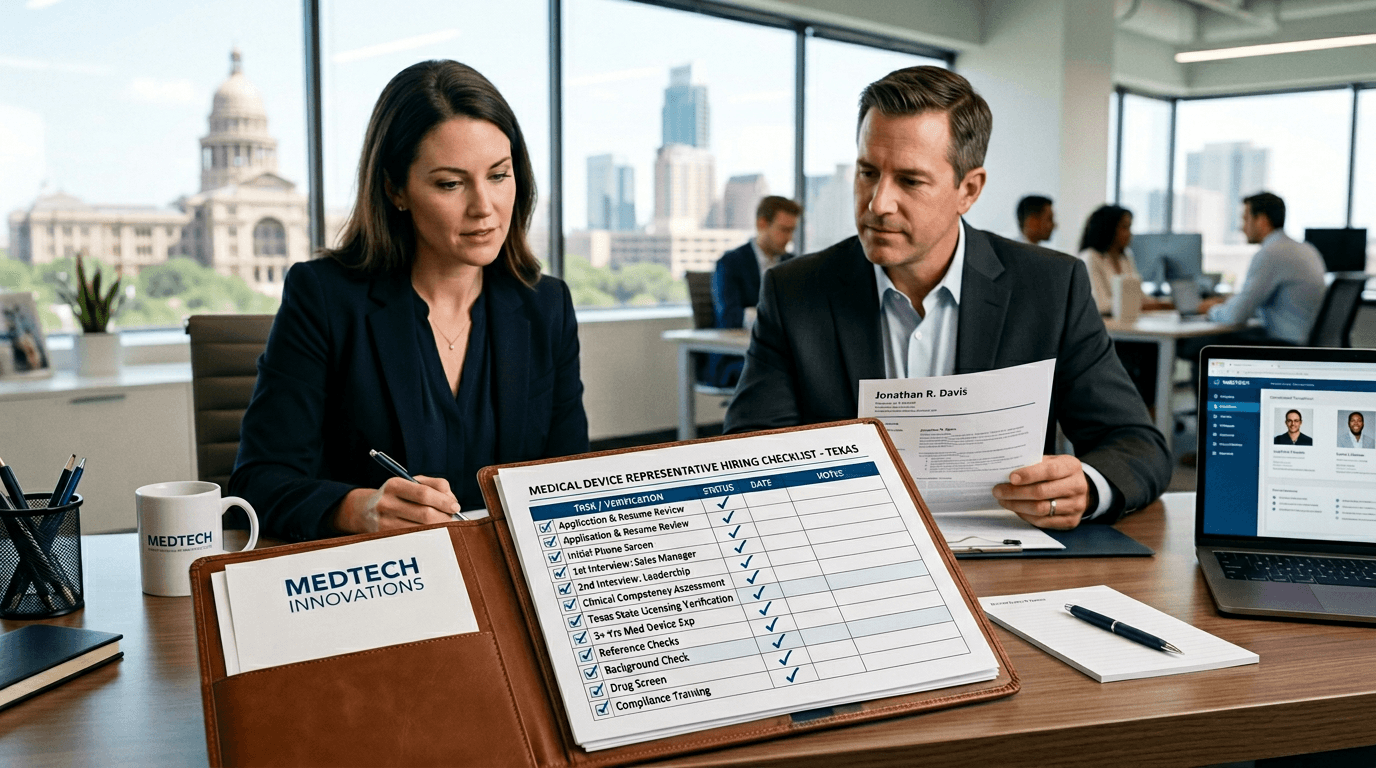
You're About to Make an Expensive Mistake (Unless You Actually Verify Things)
I've watched hiring managers prepare to hire a device rep. They do the interviews. They get excited about a candidate. They're ready to make the offer.
And I ask them one question: "Have you verified they actually have hospital access?"
Most of the time, they look confused. "What do you mean, verified? They said they've been credentialed before."
Right. They said that. But did you actually call the hospitals and confirm it? Did you ask for details about the credentialing process? Did you ask if there were any complications?
Most companies don't verify. They just trust the person says what they say. Then hiring happens, and the person shows up and can't get credentialed quickly because they left out some detail. Or they've got a gap in their background. Or the hospitals they claim experience with won't verify the relationship.
Here's the thing: hiring mistakes are expensive. If you're going to hire, spend an extra two hours verifying some basic things. It could save you $150K to $300K in losses when the hire doesn't work out.
Check 1: Can They Actually Get Hospital Credentials?
This one's foundational. If they can't get credentialed, nothing else matters.
Hospital credentialing typically takes 4 to 8 weeks. But it can take longer if there are complications. And some people can't get credentialed at all because of their background.
Ask them directly: "Have you been credentialed at hospitals before? Which hospitals? How long did it take? Were there any complications?"
If they hesitate, that's a bad sign. A real device rep knows their credentialing history because they've done it before.
Then do something most companies don't do: call one of the hospitals they claim to be credentialed at. Verify they're actually credentialed there. It takes ten minutes.
If they have credentialing at Baylor and UT Health and HCA facilities, they probably don't have barriers. If they've never been credentialed before, they're a risk. You won't know if they'll get approved until weeks into the process.
Check 2: Do They Actually Know Surgeons in Your Market?
This is harder to verify, but it's critical. If they don't know surgeons, they're starting from zero. And starting from zero in a consolidated Texas market is slow.
Ask them to name five surgeons they've worked with in your target market. Not surgeons they've heard of. Surgeons they've actually worked cases with.
If they can't name five, they don't have the relationships you need.
Then (and most companies skip this part) call one of those surgeons. Ask the surgeon if they've worked with this rep. Ask if they'd work with them again.
A real surgeon relationship will come through immediately. The surgeon will say, "Yeah, I know them. We've done cases together. They're solid."
A weak relationship will be obvious too. The surgeon will say, "I've heard of them" or "I think we've met" or worse, "I don't recall working with them."
If you call a surgeon and they don't actually know the rep, that's a red flag. The rep might have exaggerated their relationships. And relationships are your primary asset in device selling.
I watched one company hire someone who claimed to have Texas relationships. When they called the surgeons, the surgeons said, "We've seen their name but haven't worked with them." The hire was dead on arrival.
Check 3: Do They Understand the Clinical Side?
This is where you separate real device reps from people who talk a good game.
Ask them to describe a surgical procedure in detail. Not just the name. The actual procedure. What happens. What alternatives exist. Why a surgeon would choose one approach over another.
Listen for specificity. Listen for whether they've seen this procedure multiple times. Listen for whether they understand the nuance.
A real device rep can walk you through a procedure they've seen. They'll describe the technique, the challenges, the decision points. They'll sound like someone who's been in the OR and paid attention.
Someone without clinical knowledge will give you marketing-material-sounding answers. They'll talk about "clinical benefits" and "outcomes" without understanding the actual procedure.
If you're not clinical yourself, bring someone clinical to this interview. A surgeon or a clinical specialist. Have them ask the clinical questions. They'll know in five minutes if the candidate actually understands or is faking it.
Check 4: Have They Actually Navigated Hospital Dynamics?
Here's one that trips people up. Understanding hospital dynamics is not the same as visiting hospitals.
Ask them to describe a time when a surgeon wanted their device but the hospital didn't approve it immediately. How did they handle it? What was the process?
A real device rep has run into hospital resistance. They've dealt with material managers, purchasing agents, group purchasing organizations. They understand that just because a surgeon wants your device doesn't mean the hospital will approve it.
They can describe the specific steps they took. They can explain which stakeholder they worked with. They can tell you what the objection was and how they addressed it.
If they say, "That hasn't happened" or they give you a vague answer, they haven't actually navigated hospital dynamics. They might have sold into some hospitals, but they don't understand the complexity.
This matters because hospital dynamics will be your biggest obstacle. A rep who understands how to navigate them is worth way more than a rep who doesn't.
Check 5: Are They Actually Looking for a Real Opportunity or Running from Something?
This one's harder to verify but matters for retention.
Ask them why they're looking to move. Listen to the answer. Are they running away from a bad situation or running toward a good one?
A rep running away might say, "My boss was terrible" or "The company was dysfunctional" or "I didn't get along with my team." Those are warning signs. If everywhere they go is bad, maybe the problem is them.
A rep running toward something will say, "The market is saturated and I want to build something in a growing market" or "I want to work with a company that's serious about device sales" or "I'm looking for a territory I can develop."
You want the second person. They're looking for opportunity. The first person is looking to escape. And when they realize your job is also hard (because device selling is hard), they'll leave again.
Also ask them what success looks like to them. Are they money-focused? Territory-focused? Relationship-focused? If their answer doesn't align with what you're offering, misalignment will happen.
Why This Actually Matters
I get asked sometimes, "Is this vetting really necessary? Can't I just interview someone and hire them?"
Sure, you can. Lots of companies do.
And then six months later they've spent $150K to $300K trying to replace someone who couldn't do the job. They've lost market position because the territory sat empty while they figured out the hire wasn't working. They've potentially damaged their culture because other reps saw a bad hire happen and they're wondering if they're next.
Spending two hours doing real verification is the cheapest investment you can make in a device rep hire.
Percentage of device hires that fail
Average cost of failed device rep hire
Time before failure is apparent
Cost of expert vetting consultation
Get Pre-Vetted Device Reps
Don't hire blindly. Get expert vetting to find the right device rep for your market. We evaluate for hospital access, surgeon relationships, clinical knowledge, and market fit. You get someone who can actually do the job.
Get Pre-Vetted Device RepsWhat Should Actually Happen Before You Make an Offer
If you're hiring a device rep, here's what responsible vetting looks like:
Step 1: Interview them. Ask the right questions about experience, relationships, motivation.
Step 2: Verify hospital credentialing. Call the hospitals they claim to be credentialed at.
Step 3: Verify surgeon relationships. Call surgeons they claim to know. Ask if they'd recommend this person.
Step 4: Assess clinical knowledge. Have someone clinical interview them. Ask specific clinical questions about your device category.
Step 5: Understand hospital dynamics. Ask them to describe how they've navigated complex hospital situations.
Step 6: Evaluate motivation and fit. Make sure they're looking for the right opportunity, not just running from a bad situation.
This takes time. Maybe eight to ten hours of work on your part. Maybe $5K to $10K in consulting help if you bring in someone with expertise.
But it could save you $150K to $300K in losses if you catch a bad hire before you commit to it.
That's a trade worth making.
Let's Talk About Your Hiring Needs
Save yourself the hiring mistake. Use pre-vetted professionals who have already been evaluated against these criteria. We've evaluated our professionals against exactly these criteria. We know they have the skills, relationships, and knowledge to succeed in Texas markets.
Let's Talk About Your Hiring Needs